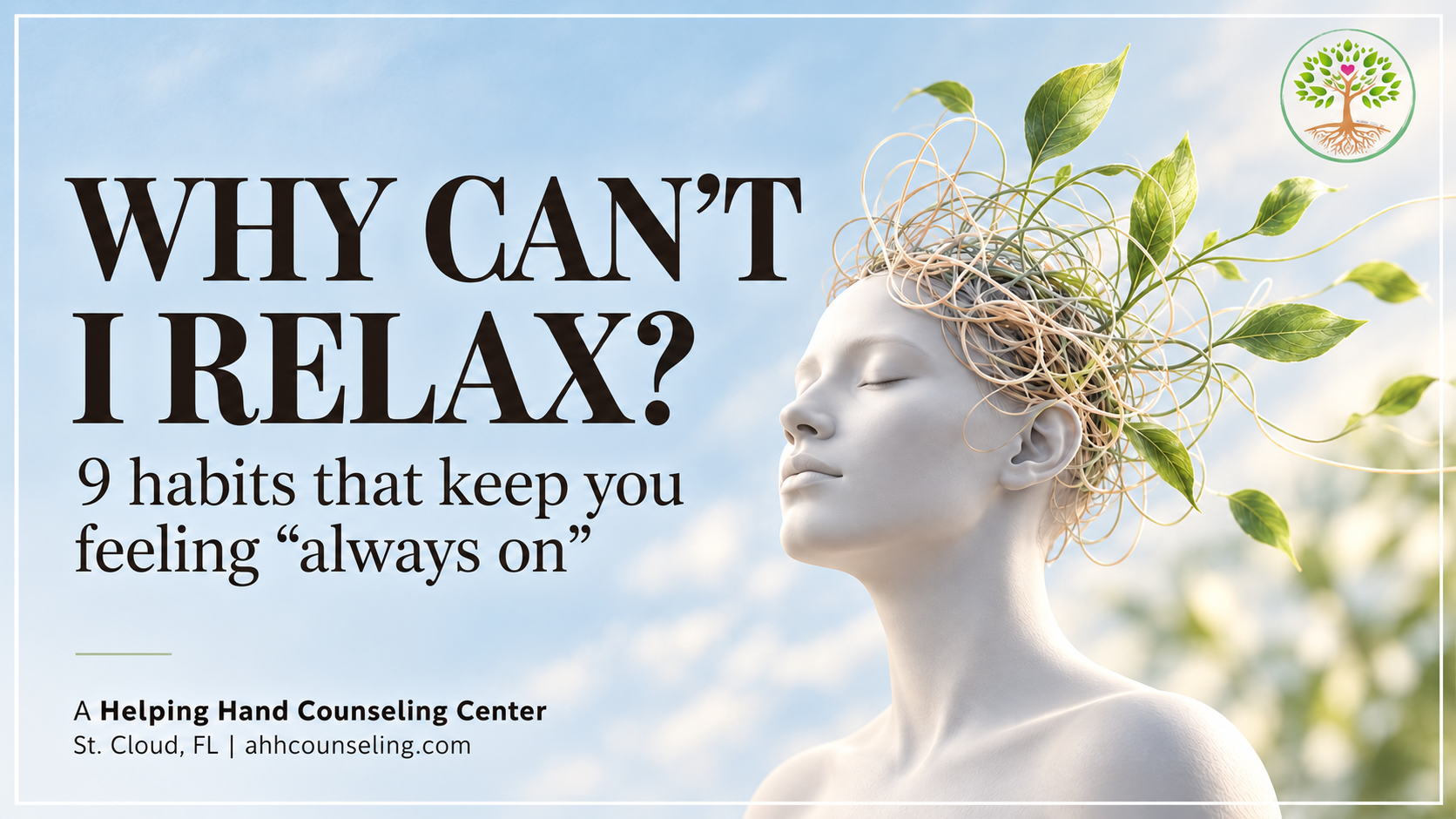
Why Can’t I Relax? 9 Everyday Habits That Keep You Feeling “Always On”
You finally sit down after a long day.
The house is quieter. Nobody needs an immediate answer. You have a little time to yourself.
But instead of relaxing, you remember the email you never answered. Then tomorrow’s appointments. Then something you said earlier that probably sounded wrong.
Your body has stopped moving. Your mind is still working overtime.
If you have ever wondered, “Why can’t I relax, even when I’m exhausted?” it can help to look at what happens around your downtime, including the expectations, routines, and worries that follow you into it.
Difficulty relaxing can have several causes. Everyday stress, persistent anxiety, sleep problems, health concerns, and demanding circumstances can all play a role. The habits below are patterns to explore, rather than a checklist for diagnosing yourself.
What to Remember When Relaxing Feels Difficult
- Notice what interrupts your downtime. Is it a notification, an unfinished task, a worry, or guilt about being unproductive?
- Give rest a place before everything is finished. An endless task list makes a difficult gatekeeper.
- Make one manageable change. You do not need to turn relaxation into another demanding project.
- Consider the demands around you. Coping strategies cannot remove every workload, caregiving responsibility, or financial pressure.
- Seek support when the pattern persists. Ongoing difficulty relaxing deserves attention when it affects sleep, relationships, work, or daily life.
Why Do I Feel “Always On”?
Feeling “always on” can mean staying mentally available for the next problem, even during time you intended to spend resting.
You might keep checking your phone, rehearse tomorrow’s conversations, or feel uneasy when nothing requires your attention.
The National Institute of Mental Health explains that stress generally responds to an external demand, while anxiety can continue even without an immediate threat. Both can affect the mind and body. Persistent symptoms that interfere with everyday life are a reason to seek professional support.
For someone balancing an Orlando commute, school pickup in St. Cloud, household responsibilities, and family needs, the practical question may be: “Where does my day actually stop?”
These nine patterns offer a place to begin.
1. You Wait Until Everything Is Finished to Rest
“I’ll relax after I answer these messages.”
“And clean the kitchen.”
“And get ahead for tomorrow.”
The problem is that tomorrow keeps arriving with more things to do.
When your rule is “finish everything first,” downtime can become something you rarely reach.
Try this: Choose one realistic stopping point before you begin your evening tasks. For example: “After dinner and the essential cleanup, I’m taking 15 minutes for myself.”
There may still be laundry in the basket. That does not automatically make the break a mistake.
Ask yourself: What actually needs to happen tonight, and what am I treating as urgent out of habit?
2. You Turn Every Quiet Moment Into Phone Time
You reach for your phone while waiting for coffee, during a television show, or as soon as you get into bed.
There is nothing inherently wrong with enjoying your phone. The useful question is whether the experience matches the break you wanted.
Did you intend to watch one funny video and end up reading work messages, upsetting headlines, and someone else’s carefully edited life?
Try this: Experiment with one short break without a feed. Listen to a song, sit outside, or drink your coffee without switching between apps.
Afterward, ask: “Do I feel more settled, more stimulated, or about the same?”
Let your own experience guide the next adjustment.
3. You Keep Your Entire To-Do List in Your Head
Remember the appointment. Buy the birthday gift. Reply to the teacher. Schedule the repair.
Even while sitting still, you may be mentally rehearsing what you cannot afford to forget.
Try this: Write a short “tomorrow list” before your evening downtime. Give each item a next step.
Instead of “deal with insurance,” write “call the number on my card during lunch.”
You are creating somewhere to return to the task. You do not have to solve it tonight.
If repetitive thinking is a familiar pattern, explore our related article on managing overthinking and quieting your mind.
4. You Say Yes Before Checking Your Capacity
Someone asks for help, and your answer comes out before you have considered your week.
Later, your downtime becomes the space where you squeeze in another commitment.
Being supportive matters. So does being honest about what you can manage.
Try this: Practice a response that gives you time:
“Let me check what I already have scheduled.”
“I can help for half an hour.”
“I’m not available this weekend.”
You can be considerate without agreeing immediately.
Ask yourself: If I say yes, what time or responsibility will I need to move?
5. You Mentally Rehearse Every Possible Problem
You imagine the difficult conversation, the missed deadline, the unexpected bill, and the backup plan for the backup plan.
Planning has a purpose. It becomes less useful when the same scenario repeats without producing new information or a decision.
Try this: Divide a page into two questions:
- What can I do about this?
- What remains uncertain?
Choose one reasonable action from the first answer. For the second, try acknowledging: “I do not know yet.”
For example, you can prepare your questions for a meeting. You cannot script every response another person might give.
If worry repeatedly takes over your evenings, individual therapy offers a space to explore those patterns and develop coping skills.
6. Your Version of Rest Comes With a Performance Goal
Your walk needs to hit a step count. Your hobby needs to become a side business. Your quiet time needs to improve your productivity.
Enjoying progress is fine. But it is useful to notice whether every activity has become another place to meet expectations.
Try this: Choose one activity without a score.
Read a few pages without setting a reading goal. Draw without posting the result. Spend time outside without tracking the walk.
Ask yourself: Would I still choose this if nobody saw it and I could not measure it?
Leave room for something you simply enjoy.
7. Your Day Has No Clear Ending
You close your laptop, answer another work message, handle household logistics, and check tomorrow’s calendar.
There is no obvious moment when you become unavailable.
Some jobs and caregiving situations make firm boundaries difficult. Even then, a small transition may be worth testing.
Try this: Create a brief closing routine:
- Record unfinished tasks.
- Identify tomorrow’s first priority.
- Close work materials.
- Move into a different activity.
That activity might be changing clothes, taking a shower, or spending a few minutes outside.
Treat the routine as an experiment. Adjust it to fit the responsibilities you actually have.
8. You Overlook Sleep and Caffeine Patterns
Sometimes the question “Why can’t I unwind?” deserves a practical look at your day.
What time was your last coffee or energy drink? Has bedtime shifted? Are late-night tasks repeatedly cutting into sleep?
NIMH includes maintaining a sleep routine, avoiding excess caffeine, and identifying stress triggers among its suggestions for coping with stress and anxiety. These habits can support care, but they do not replace treatment when it is needed.
Try this: Keep a brief record of caffeine timing, sleep, and how settled you feel in the evening. Look for patterns without expecting one explanation to account for everything.
Persistent fatigue, sleep changes, or new physical symptoms also deserve a conversation with a healthcare professional.
9. You Criticize Yourself for Struggling to Relax
“Other people handle more.”
“I should be enjoying this.”
“Why can’t I just calm down?”
Now your original discomfort comes with another problem: judging yourself for having it.
Try this: Describe the experience without adding an insult.
“I’m having trouble settling tonight.”
“I’ve had a demanding day.”
“I can try something small and see whether it helps.”
You do not have to feel perfectly calm for a break to count.
If quiet time consistently feels distressing, that is useful information to discuss with a therapist.
A Small Experiment for Tonight
Choose one habit from this article, rather than trying to change all nine.
Then finish these sentences:
- The pattern I notice most is…
- One small change I can try is…
- I will know something about its usefulness by noticing…
For example:
“I keep checking work messages during dinner. Tonight, I’ll leave my phone in another room for 20 minutes. I’ll notice how often I want to check it and what I’m worried I might miss.”
The purpose is to learn about your experience. There is no perfect relaxation score.
When Difficulty Relaxing Deserves Professional Support
Consider reaching out when worry or tension repeatedly disrupts sleep, concentration, relationships, or everyday activities.
NIMH identifies trouble relaxing, irritability, difficulty concentrating, fatigue, sleep problems, and muscle tension among possible symptoms of generalized anxiety disorder. Those experiences can also have other explanations. A qualified professional can assess the broader picture rather than relying on a symptom list alone.
You can ask for help before you reach a breaking point.
Counseling Support in St. Cloud, FL
A Helping Hand Counseling Center offers individual therapy for concerns including anxiety, stress, and life transitions. Its individual therapy page describes approaches including Cognitive Behavioral Therapy and mindfulness strategies, with care personalized to each client.
If you live in St. Cloud, Kissimmee, Harmony, Narcoossee, or a nearby community, you can begin by explaining what “always on” looks like for you.
Maybe you cannot stop planning. Maybe you feel guilty whenever you sit down. Maybe you are tired of carrying tomorrow into every evening.
Learn how to get started, contact our team, or call 407-450-5985.
Frequently Asked Questions About Difficulty Relaxing
Why can’t I relax even when I’m tired?
Feeling tired and feeling settled are different experiences. Ongoing demands, repetitive worries, daily routines, sleep difficulties, and health concerns may contribute. If the pattern persists, a healthcare or mental health professional can help explore the causes.
Does difficulty relaxing mean I have anxiety?
Difficulty relaxing alone does not establish an anxiety disorder. An assessment considers your symptoms, how long they have lasted, their impact, and possible alternative explanations. You do not need to diagnose yourself before asking for support.
Why do I feel guilty when I rest?
You may have learned to connect being useful, available, or productive with meeting expectations. Consider what you tell yourself when you stop working and whether those expectations leave room for your needs. Therapy can provide space to explore that question.
What can I try when I feel “always on”?
Start with one manageable experiment: write down tomorrow’s tasks, take a short break from notifications, or create a clear stopping point for the evening. Notice what helps rather than expecting an immediate change.
Can therapy help me learn to relax?
Therapy can help you understand persistent worry, examine expectations, and practice coping skills. CBT is a research-supported treatment commonly used for generalized anxiety disorder. The appropriate approach depends on your needs and assessment.
Where can I find counseling in St. Cloud?
A Helping Hand Counseling Center is located at 303 Commerce Center Drive, St. Cloud, FL 34769. Visit the first appointment page or call 407-450-5985 to ask about beginning care.
This article provides general education and does not replace an individualized mental health or medical assessment.
A Helping Hand Counseling Center
- 303 Commerce Center Drive St. Cloud, FL 34769
- teamcare@ahhcounseling.com
- (407) 450-5985
- www.ahhcounseling.com
Subscribe to Our Newsletter
Posts Category
Most Popular Posts

Doomscrolling vs. Bloomscrolling: Is Your Phone Making Your Anxiety Worse?
You pick up your phone to check one notification. A few minutes later, you’re reading about economic uncertainty, stressful headlines, social media arguments, and everything

How Do I Know If I Need Therapy? 10 Signs It May Be Time to Talk to a Therapist
If you’re wondering whether you need therapy, you do not have to wait until life feels unmanageable to reach out for support. Therapy may be

Is Overthinking a Sign of Anxiety? 9 Signs Your Mind May Be Stuck in an Anxiety Loop
You replay a conversation from three days ago. You write a text, delete it, rewrite it, and wonder how the other person will interpret it.
Subscribe to Our Newsletter