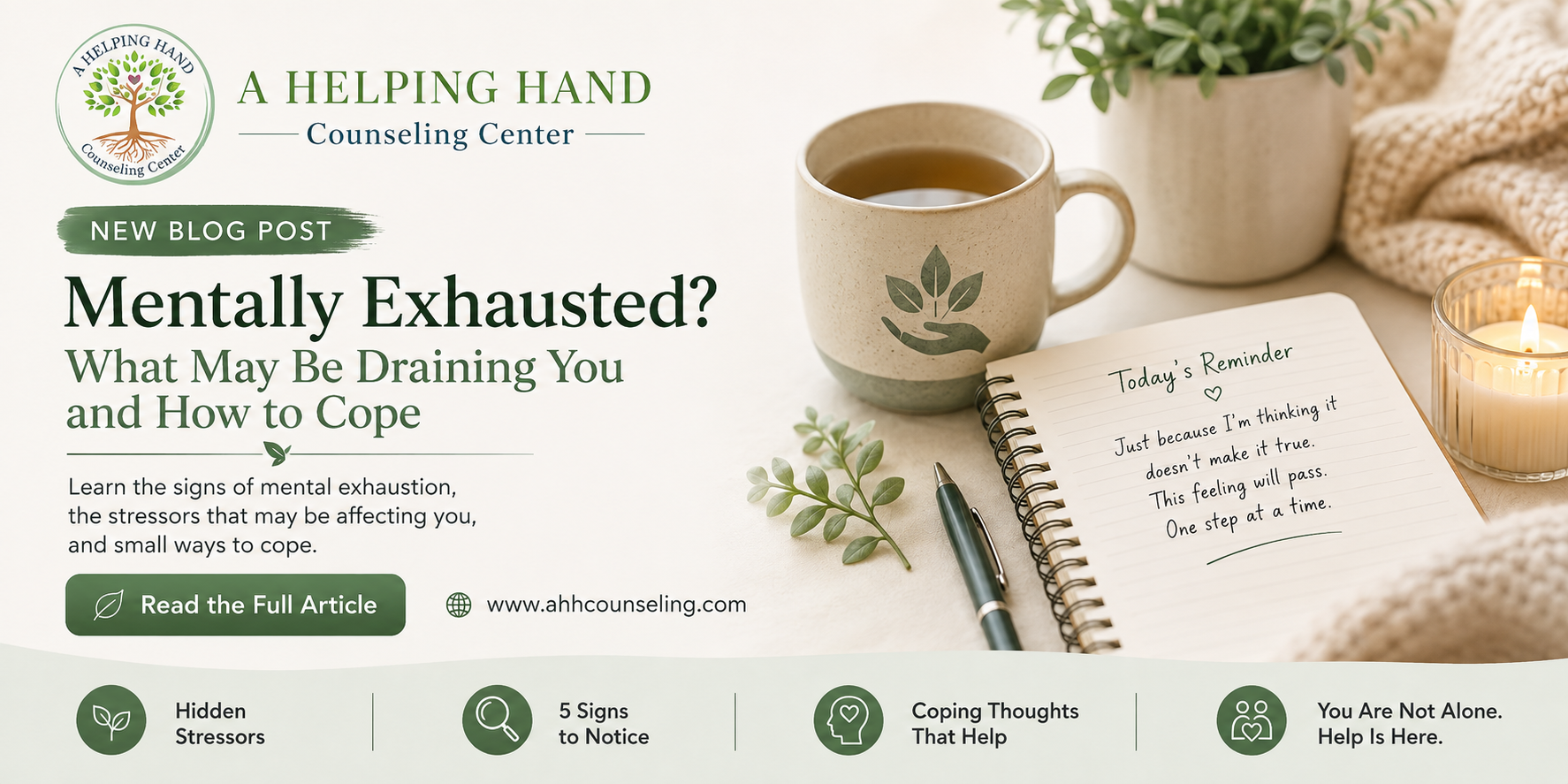
Mentally Exhausted? What May Be Draining You and How to Cope
Sometimes mental exhaustion is easy to recognize.
Other times, it hides inside everyday life.
You may still be working, taking care of responsibilities, answering messages, showing up for family, and getting through your routine. But underneath all of that, you feel tired, overwhelmed, unmotivated, or emotionally drained.
The important thing to remember is that mental health is rarely affected by just one thing.
Your schedule, sleep, relationships, physical health, financial stress, screen habits, self-talk, unresolved experiences, and the amount of time you have to recover can all influence how you feel.
This article takes a closer look at three important questions:
- What may be draining your mental health?
- How can you tell when you are becoming mentally exhausted?
- What can you tell yourself when stress and difficult thoughts start taking over?
Key Takeaways
- Mental exhaustion often develops gradually through everyday stressors.
- Feeling tired after rest, becoming overwhelmed easily, losing motivation, withdrawing socially, and feeling emotionally drained are common signs to notice.
- Sleep, work-life balance, finances, relationships, health, screen time, self-care, and unresolved stress can all affect emotional well-being.
- Coping thoughts can help create distance between what you are thinking and what is actually true.
- Small adjustments can help, but persistent distress may be a sign that additional support would be beneficial.
Part 1: What May Be Affecting Your Mental Health More Than You Realize
Mental health is shaped by what happens around you and what happens within you.
Some influences are obvious.
Others are easy to overlook because they are simply part of your normal routine.
Your Daily Schedule
A packed schedule can keep your mind in constant task mode.
Wake up.
Get ready.
Work.
Pick up the kids.
Make dinner.
Answer messages.
Finish chores.
Prepare for tomorrow.
Repeat.
Even when every individual responsibility seems manageable, the accumulation can become exhausting.
Ask yourself:
Where in my day do I actually have time to mentally recover?
If the answer is “nowhere,” that may be worth addressing.
Try this:
Look at your typical weekday and identify one place where you can create even 10 to 20 minutes of breathing room.
It could mean:
- Eating lunch away from your desk
- Sitting quietly before picking up your phone in the morning
- Taking a short walk after work
- Leaving one evening unscheduled
- Asking someone else to handle one recurring task
Small amounts of recovery time can matter.
Poor Sleep
Sleep affects far more than energy.
When sleep is disrupted, it can become harder to concentrate, regulate emotions, solve problems, and cope with frustration.
At the same time, stress and anxiety can make it harder to sleep.
That can create a loop:
Stress makes sleep harder. Poor sleep makes stress harder to manage.
If this sounds familiar, focus less on achieving “perfect sleep” and more on improving consistency.
Simple changes may include:
- Keeping a relatively consistent bedtime
- Reducing stimulating screen use before bed
- Avoiding work messages late at night when possible
- Creating a more predictable wind-down routine
- Tracking whether caffeine is affecting your sleep
Persistent sleep problems may also deserve medical or mental health attention.
Too Much Screen Time
Screen time itself is not automatically harmful.
What matters is how you use it and how you feel afterward.
There is a difference between watching something relaxing and spending an hour comparing your life to other people online.
There is a difference between checking one message and being constantly reachable.
There is also a difference between staying informed and repeatedly exposing yourself to upsetting news.
Try asking:
Does this screen time leave me feeling better, neutral, or worse?
That question can be more useful than simply counting hours.
Friends, Family, and Social Interaction
Relationships can be a source of comfort.
They can also be a major source of emotional strain.
You may feel drained if you are constantly:
- Managing someone else’s emotions
- Avoiding conflict
- Saying yes when you want to say no
- Feeling responsible for everyone
- Trying to keep the peace
- Spending time with people who leave you tense or depleted
Healthy relationships should not require you to abandon your own emotional needs.
This does not mean cutting everyone off.
Sometimes it means communicating more clearly, setting a boundary, asking for space, or recognizing which relationships require more energy than they give back.
News and Current Events
It is normal to want to stay informed.
But constant exposure to distressing news can keep your mind in a heightened state of alert.
If you frequently feel anxious, angry, helpless, or emotionally exhausted after consuming news, consider changing how you engage with it.
You might:
- Check updates once or twice a day instead of continuously
- Turn off breaking-news alerts
- Avoid news immediately before bed
- Choose a limited number of reliable sources
- Take temporary breaks when you feel overloaded
Being informed does not require being immersed in distress all day.
Financial Stress
Money worries are emotional worries too.
Financial pressure can affect sleep, relationships, confidence, decision-making, and overall stress.
You may find yourself constantly thinking about:
- Bills
- Housing
- Debt
- Medical expenses
- Childcare
- Employment
- Unexpected costs
- Whether you are “doing enough”
Sometimes financial stress becomes so constant that it fades into the background, even though your mind is still carrying it.
Simply recognizing it as a real source of emotional strain can be helpful.
Chronic Health Conditions
Physical health and mental health do not exist separately.
Living with pain, fatigue, illness, mobility challenges, appointments, medication, or uncertainty can require significant emotional energy.
You may also be grieving changes in what your body can do or how your life used to feel.
That experience deserves attention too.
Lack of Free Time
Free time is not wasted time.
It is often where recovery happens.
If every moment is filled with work, errands, parenting, caregiving, appointments, household tasks, or social obligations, your mind may never fully shift out of responsibility mode.
Ask yourself:
When was the last time I did something that had no purpose other than enjoyment or rest?
If you cannot remember, that may tell you something.
Work-Life Balance
Work stress can continue long after the workday ends.
You might physically leave work while mentally replaying:
- Conversations
- Deadlines
- Mistakes
- Emails
- Tomorrow’s responsibilities
- Workplace tension
If your brain is always at work, your body may never feel completely off duty.
A helpful starting point is creating one clear transition ritual between work and home.
It might be:
- Changing clothes
- Taking a short walk
- Listening to music during the commute
- Turning off work notifications
- Writing tomorrow’s tasks down before leaving
The goal is to give your mind a signal that the workday is over.
Physical Activity
Movement can support overall mental wellness, but it does not have to mean an intense workout.
Walking, stretching, gardening, playing with your children, swimming, dancing, or other enjoyable movement can all count.
The goal is not punishment.
It is giving your body an opportunity to move, release tension, and shift gears.
Diet and Everyday Habits
Mental health can also be affected by things that seem purely physical.
Eating inconsistently, relying heavily on caffeine, dehydration, alcohol use, or other habits can influence energy and mood.
There is no need to pursue a perfect routine.
Instead, look for patterns.
What tends to happen on the days when you feel your best?
What tends to happen on the days when you feel depleted?
Monthly or Hormonal Changes
Hormonal changes can affect mood, sleep, energy, concentration, and emotional sensitivity.
If you notice that symptoms repeatedly appear at similar times each month, tracking them may help you recognize a pattern.
That information can also be useful when speaking with a healthcare provider.
Substance Use
Some people turn to alcohol or other substances because they provide temporary relief from stress, anxiety, sadness, or emotional discomfort.
But temporary relief can sometimes create longer-term difficulties.
If substance use is becoming your primary way of coping, that is worth paying attention to.
Unresolved Trauma
Past experiences can continue influencing present-day reactions.
You may notice:
- Strong emotional responses
- Avoidance
- Hypervigilance
- Difficulty trusting others
- Repeated relationship patterns
- Intrusive memories
- Feeling emotionally disconnected
- Physical reactions that seem disproportionate to the current situation
Trauma does not always announce itself clearly.
Sometimes it shows up through patterns.
If you recognize yourself in several of these areas, it may help to talk through what has been carrying the most weight. A Helping Hand Counseling Center offers support for stress, anxiety, trauma, relationships, and other emotional concerns.
Part 2: Five Signs You May Be Mentally Exhausted
Mental exhaustion often shows up before we consciously realize how stressed we have become.
These five signs are especially worth noticing.
1. You Feel Tired Even After Resting
You may sleep and still feel depleted.
You may take a weekend off and still feel mentally heavy.
You may sit down to relax, but your mind keeps running.
Sometimes this means the kind of rest you are getting is not addressing the kind of exhaustion you are experiencing.
Physical rest helps the body.
Emotional recovery may require something different.
2. Small Things Start Feeling Huge
A small inconvenience feels overwhelming.
A simple decision feels exhausting.
An unexpected change ruins your entire mood.
When your emotional capacity is already low, minor stressors can feel much bigger.
Think of it like a glass that is already nearly full.
It may only take one small additional stressor for it to overflow.
3. You Lose Motivation
You know what needs to be done, but starting feels difficult.
Things you usually enjoy feel like work.
You may procrastinate more or stop caring about goals that used to matter.
That loss of motivation can sometimes be your mind’s way of signaling overload.
4. You Avoid Social Interaction
You may stop replying to messages.
You cancel plans.
You feel relief when someone else cancels.
You want to be alone because conversation feels like effort.
There is nothing wrong with needing solitude.
But if withdrawal becomes your default and you no longer feel connected to people you care about, it may be worth exploring why.
5. You Feel Emotionally Drained
You may feel:
- Irritable
- Numb
- Tearful
- Restless
- Disconnected
- Overly sensitive
- Easily frustrated
- Completely “done”
Emotional exhaustion does not look the same for everyone.
Some people feel everything.
Others feel almost nothing.
Both can be signs that your system needs support.
A Quick Self-Check
Ask yourself how many of these statements feel true lately:
- I feel tired even when I rest.
- Little things frustrate me more than usual.
- I have trouble concentrating.
- I keep putting off basic tasks.
- I do not feel like talking to anyone.
- I have lost interest in things I normally enjoy.
- My mind feels constantly busy.
- I feel emotionally numb or overwhelmed.
- I am going through the motions instead of feeling present.
You do not need to score yourself.
The purpose is simply to notice patterns.
Part 3: What Are You Saying to Yourself While You Are Struggling?
One of the most overlooked influences on mental health is self-talk.
Your mind produces thoughts constantly.
But thoughts are not automatically facts.
That distinction becomes especially important when you are stressed.
Imagine your friend sends you:
“Can we talk later?”
Your mind may immediately respond:
“I did something wrong.”
“They are angry.”
“This is going to be bad.”
But those are predictions.
Not facts.
Learning to separate the two can reduce unnecessary emotional escalation.
Coping Thought #1: “Just Because I Am Thinking It Does Not Make It True”
This is one of the most useful reminders when anxiety starts filling in missing information.
Instead of:
“Something bad is definitely going to happen.”
Try:
“My mind is predicting something bad. I do not know that it is true.”
That small language change creates space.
Coping Thought #2: “This Hurts, So I Need to Be Kinder to Myself”
People are often hardest on themselves when they are already struggling.
You may think:
“I should be stronger.”
“I should be handling this better.”
“Why can’t I get it together?”
Try replacing criticism with curiosity.
“I am having a hard time. What would actually help me right now?”
That question is usually more productive.
Coping Thought #3: “This Feeling Is Uncomfortable, but It Will Pass”
Strong emotions can feel permanent while you are experiencing them.
Anxiety says it will never stop.
Sadness says you will always feel this way.
Anger says the situation will never improve.
But emotions change.
You do not need to force them away.
Sometimes it is enough to remind yourself:
“I can feel this without assuming I will feel it forever.”
Coping Thought #4: “This Is Hard, but It Is Not Everything”
Stress can narrow your attention.
One bad interaction becomes a bad day.
One bad day becomes a bad week.
One problem becomes “everything is going wrong.”
Try separating the problem from the rest of your life.
“This part is difficult. That does not mean everything is.”
Coping Thought #5: “I Can Be Flexible”
Not everything will go according to plan.
Plans change.
People disappoint us.
Unexpected things happen.
You do not have to like what happened in order to adapt to it.
Try:
“This is not what I wanted, but I can decide what to do next.”
Coping Thought #6: “It Is Okay to Have a Not-Okay Day”
Not every day needs to become a success story.
Sometimes you are tired.
Sometimes you are upset.
Sometimes things are simply difficult.
One difficult day does not erase your progress.
Coping Thought #7: “I Have Made It Through Hard Things Before”
This does not mean minimizing what you are currently facing.
It means remembering evidence of your own ability to cope.
When your mind says:
“I cannot do this.”
Try asking:
“What have I already survived that I once thought I could not handle?”
Create Your Own Coping Statement
The best coping thought is not necessarily the most positive one.
It is the one you actually believe.
Use this formula:
What am I afraid is true?
Then ask:
What is a more balanced version of that thought?
For example:
“I am going to mess everything up.”
Becomes:
“I might make mistakes, but I can deal with problems as they come.”
Or:
“No one understands me.”
Becomes:
“I feel alone right now, but there may be someone I can talk to.”
Part 4: What Can You Do When Your Mental Battery Feels Low?
When you are already exhausted, a 25-step wellness plan is not helpful.
Start smaller.
If You Are Overwhelmed
Ask:
What actually needs to happen today?
Not this week.
Not eventually.
Today.
Choose the one or two most important things.
Let the rest wait when possible.
If Your Mind Will Not Stop
Write down everything you are carrying mentally.
Tasks.
Worries.
Questions.
Things you are afraid you will forget.
Sometimes getting thoughts onto paper reduces the pressure of trying to hold everything in your head.
If You Are Constantly Scrolling
Create one phone-free pocket of time.
Ten minutes counts.
Thirty minutes is even better.
Choose a part of your day where your mind can exist without constant incoming information.
If You Are Withdrawing
You do not need to become highly social.
Reach out to one safe person.
A simple message is enough:
“It’s been a hard week. Do you have time to talk?”
Connection does not have to be complicated.
If Your Self-Talk Is Harsh
Catch one sentence.
Just one.
Then ask:
Would I say this to someone I care about?
If not, rewrite it.
If You Feel Completely Drained
Ask a different question.
Instead of:
“How can I get more done?”
Ask:
“What can I stop carrying today?”
That shift alone can be powerful.
The Mental Energy Audit
Here is a simple exercise you can do this week.
Create two columns.
What Drains Me
Write down things that consistently take energy from you.
Examples:
- Certain conversations
- Work emails after hours
- Lack of sleep
- Social media
- Financial worry
- Overscheduling
- Family conflict
- Negative self-talk
- News consumption
- Feeling responsible for everyone
What Restores Me
Write down things that genuinely help you feel more grounded.
Examples:
- Being outside
- Quiet time
- Music
- A supportive friend
- Movement
- Prayer or meditation
- Reading
- Creative activities
- Therapy
- Time with family
- Having no plans
Then look at the balance.
Is your week mostly withdrawals?
If so, the goal is not to remove every stressor.
It is to intentionally add more recovery.
Part 5: When It May Be Time for More Support
Self-care is valuable.
But sometimes self-care is not enough.
Professional support may be worth considering when:
- Stress feels constant
- Emotional exhaustion keeps returning
- Anxiety is affecting daily life
- You are withdrawing from people
- Motivation has significantly changed
- Sleep problems continue
- Past experiences are affecting your present
- Your relationships feel increasingly difficult
- You feel stuck in the same thought patterns
- Coping strategies are no longer helping
Therapy does not require you to be in crisis.
It can also help you understand patterns before they become more disruptive.
What Therapy Can Help You Explore
Depending on what you are experiencing, counseling may help you:
- Identify sources of stress
- Understand emotional triggers
- Develop healthier coping skills
- Challenge unhelpful thought patterns
- Improve communication
- Set boundaries
- Process grief
- Work through trauma
- Navigate relationship difficulties
- Manage anxiety or depression
- Improve emotional regulation
- Build routines that better support your mental health
A Helping Hand Counseling Center provides a range of mental health services for individuals and families, including counseling, trauma-focused care, and psychiatric support.
If you keep telling yourself, “I should be able to handle this,” consider asking a different question: “Would support make this easier to navigate?”
Frequently Asked Questions
What causes mental exhaustion?
Mental exhaustion can develop from prolonged stress, lack of sleep, work pressure, relationship difficulties, financial concerns, caregiving, health issues, trauma, constant mental stimulation, or a combination of factors.
Often, it is not one major event.
It is the accumulation of many smaller demands.
How do I know if I am mentally exhausted?
Common signs include feeling tired even after resting, becoming overwhelmed by small tasks, losing motivation, withdrawing socially, difficulty concentrating, irritability, emotional numbness, or feeling emotionally drained.
Can overthinking cause mental exhaustion?
Yes.
Constantly replaying situations, predicting negative outcomes, analyzing conversations, or worrying about future problems can use a significant amount of mental energy.
Learning to distinguish between thoughts and facts can help reduce that cycle.
What is a good coping thought for anxiety?
A useful coping thought should feel realistic and believable.
Examples include:
- “I do not know that this thought is true.”
- “I can take this one step at a time.”
- “This feeling will change.”
- “I do not have to solve everything right now.”
- “I can focus on what I can control.”
Why do small things feel overwhelming when I am stressed?
When your mental and emotional capacity is already stretched, even minor demands can feel significant.
The problem may not be the small task itself.
It may be that you have very little emotional bandwidth left.
Can poor sleep make mental exhaustion worse?
Yes.
Poor sleep can make concentration, emotional regulation, decision-making, and stress management more difficult.
Stress can also interfere with sleep, creating a cycle that reinforces exhaustion.
Is social withdrawal a sign that I need therapy?
Not necessarily by itself.
Everyone needs alone time.
However, if you are increasingly isolating yourself, avoiding people you normally enjoy, or withdrawing because you feel anxious, depressed, or emotionally depleted, speaking with a mental health professional may be helpful.
Do I need to be in crisis before seeing a therapist?
No.
Therapy can support people with everyday stress, relationship concerns, anxiety, life transitions, grief, personal growth, trauma, and emotional wellness.
You do not have to wait until things become unbearable.
One Final Question
Before you move on with your day, ask yourself:
What has been taking the most energy from me lately?
Do not judge the answer.
Notice it.
Then ask:
What is one thing I could do to make that load slightly lighter?
You do not have to fix everything at once.
Sometimes the next step is a boundary.
Sometimes it is rest.
Sometimes it is changing the way you speak to yourself.
And sometimes it is allowing someone else to help you carry what has become too heavy.
If stress, anxiety, emotional exhaustion, trauma, or relationship concerns are beginning to interfere with your daily life, A Helping Hand Counseling Center can help you explore your options for support.
A Helping Hand Counseling Center
- 303 Commerce Center Drive St. Cloud, FL 34769
- teamcare@ahhcounseling.com
- (407) 450-5985
- www.ahhcounseling.com
Subscribe to Our Newsletter
Posts Category
Most Popular Posts

How Do I Know If I Need Therapy? 10 Signs It May Be Time to Talk to a Therapist
If you’re wondering whether you need therapy, you do not have to wait until life feels unmanageable to reach out for support. Therapy may be

Is Overthinking a Sign of Anxiety? 9 Signs Your Mind May Be Stuck in an Anxiety Loop
You replay a conversation from three days ago. You write a text, delete it, rewrite it, and wonder how the other person will interpret it.

Is September Suicide Prevention Month? What Should You Know About Suicide Prevention and Mental Health Support?
Yes. September is Suicide Prevention Awareness Month, a nationwide observance dedicated to raising awareness about suicide, reducing stigma around seeking help, connecting people with resources,
Subscribe to Our Newsletter