What Good Counseling Actually Feels Like
A practical guide to finding support that feels safe, useful, and right for you
There is a difference between going to counseling and feeling like counseling is actually helping.
When people first consider talking with a counselor, they often focus on the practical questions first.
Do they take my insurance?
Are they close to home?
Do they work with anxiety?
Can they help my child?
Will I feel comfortable talking with them?
Those questions matter.
But there is another question that can be harder to answer:
How do you know when you have found the right place to get help?
Good counseling is not about finding someone who has all the answers for you. It is about having a space where you can be honest, begin making sense of what you are experiencing, and work with someone who has the training to help you move forward.
Every counseling experience is different, but there are a few things quality mental health care should have in common.
Key Takeaways
- Good counseling should feel collaborative, respectful, and focused on what matters to you.
- You do not need a diagnosis or a perfect explanation before contacting a counselor.
- Finding the right counselor involves more than credentials. Experience, communication style, therapeutic approach, accessibility, and comfort all matter.
- Counseling can be helpful before a concern becomes a crisis.
- A counseling center with multiple providers may offer more options for children, teens, adults, couples, and families.
- Having mental health care close to home can make attending counseling consistently easier for individuals and families in St. Cloud and surrounding communities.
1. You Should Feel Like You Are Talking to a Person, Not Being Analyzed
One of the biggest misconceptions about counseling is that you sit down, tell a stranger everything that is wrong, and they immediately begin analyzing you.
Good counseling usually feels much more human than that.
There is conversation. There are questions. Sometimes there is laughter. Sometimes there are long pauses. Sometimes you spend an appointment talking about something you never expected to discuss when you walked through the door.
A good counselor is listening for more than symptoms.
They are getting to know you.
They want to understand your experiences, your relationships, the things that are weighing on you, what you have already tried, and what you would like life to look like if things started getting better.
That relationship matters because counseling is not simply something that is done to you.
It is something you and your counselor work on together.
2. You Do Not Need the Perfect Explanation for Why You Are There
People sometimes hesitate to contact a counseling center because they do not quite know what to say.
Maybe you have been feeling anxious, but you are not sure whether it is actually anxiety.
Maybe your child has been struggling emotionally or behaviorally, and you cannot figure out why.
Maybe your relationship does not feel the way it used to.
Maybe nothing feels dramatically wrong, but you have been overwhelmed, disconnected, exhausted, irritable, stuck, or simply unlike yourself.
You do not need to diagnose yourself before asking for help.
Part of mental health counseling is making sense of what you have been experiencing.
Sometimes the most useful place to begin is simply:
“I am not really sure what is going on, but I know I have not been feeling like myself.”
That is enough to start a conversation.
3. The Right Counselor Does Not Have to Be the Right Counselor for Everyone
A counselor can be highly qualified and still not be the best fit for every person.
People are different. Counselors are too.
Some clients respond well to someone warm and conversational.
Others appreciate a more direct approach.
Some people want practical strategies they can begin using immediately. Others need room to process experiences they may have been carrying for years.
The kind of support an adult needs may also look very different from what works for a child, teenager, couple, or family.
That is one of the advantages of choosing a counseling center with multiple mental health professionals.
Instead of trying to make every person fit one therapeutic style, a practice may be able to connect clients with someone whose experience and approach align more closely with their needs.
The important question is not whether a counselor is the perfect counselor for everyone.
It is whether that counselor is a good fit for you.
4. Good Counseling Should Have Direction Without Feeling Rushed
Counseling should not feel like an endless conversation with no purpose.
At the same time, it should not feel like a race toward being “fixed.”
There should be some understanding of why you are there and what you would like to work toward.
Your goal might be specific:
- managing anxiety or panic
- processing trauma
- improving communication in a relationship
- helping your child regulate emotions
- setting healthier boundaries
- coping with grief
- reducing stress
- improving family relationships
- understanding patterns that keep repeating
Or your goal may begin much more simply:
“I want to feel better.”
That is okay too.
The goal can become clearer as counseling continues.
Progress is not always dramatic.
Sometimes progress means reacting differently to something that once overwhelmed you.
Sometimes it means having a difficult conversation you used to avoid.
Sometimes it is recognizing a pattern sooner.
Sometimes it is learning how to calm yourself before stress takes over.
Sometimes it is beginning to understand why certain situations affect you so strongly.
Small changes can be meaningful changes.
5. The Environment Matters More Than People Think
The place where counseling happens can influence how comfortable the experience feels.
If you are already nervous about your first appointment, walking into an environment that feels confusing, overly clinical, or impersonal can make the process feel harder.
Privacy matters.
Comfort matters.
Feeling welcomed matters.
Practical details matter too.
Knowing where to park, where to check in, what the office is like, and what will happen when you arrive can reduce some of the uncertainty surrounding a first appointment.
For children, the environment can be even more important. Younger clients may communicate and process emotions differently from adults, which is why therapy spaces designed with children in mind can help support the counseling process.
A thoughtful counseling environment does not replace good clinical care, but it can make it easier to begin.
6. You Should Be Able to Ask Practical Questions
Choosing counseling is not purely an emotional decision.
Real life matters.
Can I use my insurance?
How soon can I schedule?
Do you work with children?
Do you provide couples counseling?
What happens at my first appointment?
Do you offer different types of therapy?
What happens if I am not sure what kind of counselor I need?
These are not secondary questions.
For many people, they determine whether getting help is realistically possible.
A good counseling center should be willing to explain the process clearly and help you understand what your next step looks like.
You should not have to become an expert on mental health care before making your first appointment.
7. Counseling Should Not Require You to Be in Crisis
There is a persistent idea that counseling is only for moments when life has completely fallen apart.
It is not.
People seek counseling because they are struggling.
They also seek counseling because they do not want things to reach that point.
You can talk with a counselor when something hurts.
You can talk with a counselor when something feels confusing.
You can talk with a counselor because a relationship matters enough to work on.
You can seek counseling because you are worried about your child.
You can seek counseling because the same patterns keep repeating.
You can talk with someone because stress has started taking up more space in your life than you want it to.
And you can begin counseling simply because handling everything on your own does not seem to be working anymore.
You do not need a dramatic reason.
You just need a reason that matters to you.
Finding the Right Support Close to Home
When life already feels complicated, getting help should not add another layer of difficulty.
Having counseling available close to home can make it easier to attend appointments consistently, especially for parents balancing school schedules, couples coordinating calendars, and people fitting mental health care around work and family responsibilities.
For people in St. Cloud and surrounding Central Florida communities, location may be one part of the decision.
But proximity should not be the only thing you consider.
If you have ever searched online for counseling near you, you have probably seen directories, individual therapists, large practices, small counseling centers, and telehealth options.
Instead of choosing solely based on who appears closest on a map, consider three questions:
Can this practice help with what I am experiencing?
Can I realistically access the care they provide?
Do I feel comfortable taking the next step with them?
Those questions tend to be much more useful than simply asking who is nearest.
What to Look for in a Counseling Center
A counseling center should make it reasonably easy to understand who they help and what they provide.
Start by looking at the people they serve.
Do they work primarily with adults, or do they also provide counseling for children, teens, couples, and families?
Then look at the concerns their providers commonly address.
If you are seeking support for anxiety, trauma, depression, family conflict, relationship concerns, grief, behavioral challenges, or another specific issue, look for a practice with professionals who have relevant experience.
You can also consider:
- counselor credentials and experience
- therapeutic approaches
- age groups served
- individual, couples, or family counseling options
- insurance participation
- self-pay options
- office location
- scheduling availability
- communication from the practice
- whether you feel comfortable asking questions
No single item tells you whether a counseling center is right for you.
Together, they can help you make a more informed choice.
What Happens During the First Counseling Appointment?
Your first appointment is usually a starting point.
Your counselor may ask about what brought you in, what has been happening recently, your history, relationships, symptoms, stressors, and what you hope counseling will help you change.
You do not need to tell your entire life story in one session.
You also do not need to arrive with a perfectly organized list of problems.
The first appointment helps your counselor begin understanding the bigger picture and gives you a chance to see what it feels like to talk with them.
Trust develops over time.
Your first session is the beginning of that process, not a test you need to prepare for.
How Do You Know If Counseling Is Helping?
There is no single measure of progress.
You may begin noticing changes in how you think, react, communicate, or cope.
You might feel more aware of what triggers certain emotions.
You may notice that difficult situations still bother you, but they no longer overwhelm you in quite the same way.
Relationships may begin feeling different.
You may start making decisions with greater clarity.
Or you may simply feel like you understand yourself better than you did before.
It is also okay to talk openly with your counselor about whether therapy feels useful.
Questions like these are completely appropriate:
“What are we working toward?”
“Do you think I am making progress?”
“Is there something I should be doing differently?”
“Would another approach be helpful?”
Counseling should be a process you participate in, not something happening around you without explanation.
Counseling in St. Cloud, Florida
A Helping Hand Counseling Center provides mental health counseling for children, teens, adults, couples, and families in St. Cloud and surrounding Central Florida communities.
Rather than expecting every client to need the same kind of support, the goal is to help connect people with care that makes sense for their circumstances, concerns, and goals.
For some people, that may mean individual counseling.
For others, it may involve couples counseling, family therapy, child-focused services, trauma-focused treatment, or additional mental health support.
The first step does not have to be knowing exactly what kind of therapy you need.
Sometimes the first step is simply starting the conversation.
Frequently Asked Questions About Counseling
What is the difference between counseling and therapy?
The words counseling and therapy are often used interchangeably. Both generally refer to working with a trained mental health professional to address emotional, behavioral, relationship, or mental health concerns. Specific provider credentials, treatment approaches, and areas of practice can vary.
How do I know if I need counseling?
You do not need to be experiencing a crisis to consider counseling. It may be helpful if stress, emotions, thoughts, relationships, behaviors, or past experiences are interfering with daily life, or if you simply feel that additional support could help.
What should I look for when choosing a counseling center?
Consider the qualifications and experience of the providers, the populations they serve, areas of focus, treatment approaches, insurance and payment options, location, scheduling, and how comfortable you feel communicating with the practice.
Is it normal to feel nervous before starting counseling?
Yes. Talking with someone new about personal experiences can feel unfamiliar. A first counseling appointment is usually focused on beginning to understand your concerns and goals, not expecting you to share everything immediately.
Do I need to know what type of therapy I need?
No. Many people begin counseling without knowing which therapeutic approach is appropriate. A mental health professional can discuss your concerns and help determine what options may make sense.
How long does counseling take?
There is no universal timeline. The length of counseling depends on your goals, concerns, circumstances, treatment approach, and how you respond to therapy. Some people seek short-term support for a specific concern, while others benefit from longer-term counseling.
Can children and teenagers go to counseling?
Yes. Counseling can support children and teens experiencing emotional, behavioral, social, family, or mental health challenges. Treatment approaches are often adapted based on the child’s age, development, needs, and family circumstances.
Can couples go to counseling even if they are not considering separation?
Yes. Couples counseling is not only for relationships in crisis. Couples may seek support to improve communication, navigate major changes, address recurring conflict, rebuild connection, or strengthen their relationship.
Is there counseling available in St. Cloud, FL?
Yes. A Helping Hand Counseling Center provides mental health counseling in St. Cloud, Florida for children, teens, adults, couples, and families, along with additional behavioral health services.
How do I find counseling near me?
Start by looking for licensed mental health providers or counseling centers in your area that work with the concerns you want to address. Review the practice’s services, provider backgrounds, insurance participation, location, availability, and treatment approach. The nearest counselor is not always the best fit, so consider both convenience and the quality of the match.
Taking the First Step
You do not have to know exactly what is wrong.
You do not have to know which counselor you need.
And you do not have to wait until things become unbearable.
Sometimes getting started simply means deciding that what you are experiencing deserves your attention.
If you are considering counseling in St. Cloud, A Helping Hand Counseling Center can help you learn more about available services, providers, insurance options, and next steps.
The goal is not to have everything figured out before you reach out.
The goal is simply to begin.
A Helping Hand Counseling Center
- 303 Commerce Center Drive St. Cloud, FL 34769
- teamcare@ahhcounseling.com
- (407) 450-5985
- www.ahhcounseling.com
Subscribe to Our Newsletter
Posts Category
Most Popular Posts
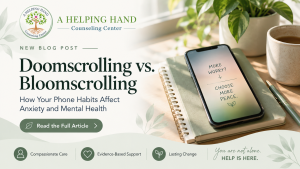
Doomscrolling vs. Bloomscrolling: Is Your Phone Making Your Anxiety Worse?
You pick up your phone to check one notification. A few minutes later, you’re reading about economic uncertainty, stressful headlines, social media arguments, and everything

How Do I Know If I Need Therapy? 10 Signs It May Be Time to Talk to a Therapist
If you’re wondering whether you need therapy, you do not have to wait until life feels unmanageable to reach out for support. Therapy may be

Is Overthinking a Sign of Anxiety? 9 Signs Your Mind May Be Stuck in an Anxiety Loop
You replay a conversation from three days ago. You write a text, delete it, rewrite it, and wonder how the other person will interpret it.
Subscribe to Our Newsletter